
The Support at Home (SAH) Program commenced on 1 November 2025 (Department of Health, Disability and Ageing, 2026a). It replaced the legacy Home Care Packages (HCP) Program and the Short-Term Restorative Care (STRC) Programme with a single, eight-classification funding model that reshapes how home care is funded, delivered, and evidenced. The Commonwealth Home Support Programme (CHSP) is not yet part of this consolidation — CHSP continues to run as a separate program, with transition into SAH not scheduled before 1 July 2027 (Department of Health, Disability and Ageing, 2026a).
For home care providers, the L&D implications are significant. SAH is not a rebadging of HCP. The workforce composition, the training requirements, the evidence trail, and the compliance overlap with the strengthened Aged Care Quality Standards are all different.
This guide walks through what SAH actually changes for L&D, the workforce composition shift from a domiciliary-care-worker model to a multidisciplinary classification model, training implications by support category, the mobile-workforce delivery challenges, and a sample SAH-aligned training matrix snippet.
A short overview of the SAH program
SAH is the Australian Government's consolidated home care funding model for people previously supported through HCP and STRC. Where HCP and STRC previously sat as separate programs with different funding logic, eligibility, and service categorisation, SAH brings them into a single framework (Department of Health, Disability and Ageing, 2026b).
The headline changes for providers:
- Single program, classification-based: Instead of HCP packages 1 to 4, clients receive one of eight SAH classifications with a budget aligned to assessed need (Department of Health, Disability and Ageing, 2026b).
- Service categories: Services are grouped into clinical, allied health, restorative, end-of-life, and hospitality/practical-support categories, with funding flowing through each.
- Provider accountability: Providers are accountable for both delivery and outcomes under the Strengthened Standards as they apply to in-home delivery, which also commenced on 1 November 2025 alongside the new Aged Care Act 2024 (Aged Care Quality and Safety Commission, 2025).
- Workforce flexibility: SAH is workforce-agnostic in funding terms. Providers can use the workforce composition that fits the client's needs, but accountability for training and competence remains.
The operational shift from HCP is more than administrative. The way services are categorised, the way workforce is deployed, and the way evidence is produced all change.
Workforce composition shift
Under HCP, the dominant workforce model was the domiciliary care worker (DCW) plus visiting clinical staff. Most hours of service in a typical package were delivered by DCWs, with clinical input layered in for specific care needs.
Under SAH, the workforce composition is reshaped around the support category structure. A client whose budget is weighted to clinical needs will see more nursing and allied health hours and fewer DCW hours. A client whose budget is weighted to restorative care will see more allied health (physiotherapy, occupational therapy) hours.
For L&D, the implication is that workforce composition is now client-dependent, not provider-default. Training planning has to support a more variable workforce mix:
- More allied-health hours delivered by external providers under sub-contract arrangements
- More nursing time delivered to client homes (not just in residential settings)
- More end-of-life care delivered in the home, requiring expanded palliative-care competence
- Restorative-care competencies (mobility, ADLs, supported self-management) becoming central rather than peripheral
Training implications by support category
The SAH support categories map to distinct training requirements. The table below outlines the core training implications for each.
| Support category | Workforce involved | Core training implications |
|---|---|---|
| Clinical care | RN, EN, GP, specialist nurses | Standard 5 Outcomes 5.1-5.7 applied in home setting; remote clinical assessment; medication management in unsupervised settings (Aged Care Quality and Safety Commission, 2025) |
| Allied health | Physiotherapist, OT, podiatrist, dietitian, speech pathologist | Scope of practice; SAH funding rules; interdisciplinary handover; documentation for funder requirements |
| Restorative care | Allied health, restorative-care workers | Reablement principles; goal-setting with the client; supporting independence over dependence; outcome measurement |
| End-of-life care | RN, EN, PCA, palliative-care specialist | Advance care planning; palliative competencies; bereavement support; integration with palliative-care providers |
| Personal care (hospitality and practical support) | PCA, domiciliary care worker | Dignity in the home setting; safety in unfamiliar environments; client choice; observation and escalation |
The operational pattern across all five categories: more autonomy for the worker (they are alone in a client's home), more interdisciplinary collaboration (multiple providers per client), and more compliance overlap with the Strengthened Standards as they apply to in-home delivery.
Compliance overlap with the Strengthened Standards
The Strengthened Aged Care Quality Standards apply to home care delivery as they apply to residential care, with some adaptations for setting (Aged Care Quality and Safety Commission, 2025). Five Outcomes are particularly relevant for SAH providers:
- Outcome 1.1 (Person-centred care): The client's home is the setting. The plan reflects their preferences and routine (Department of Health, Disability and Ageing, 2025).
- Outcome 2.5 (Incident management): Incidents in the home (falls, near-misses, medication errors) need to be reported and reviewed (Department of Health, Disability and Ageing, 2025).
- Outcome 3.3 (Communicating for safety and quality): Multi-provider scenarios are the norm. Handover quality is critical (Aged Care Quality and Safety Commission, 2025).
- Outcome 5.5 (Safety of clinical care services): Covers recognising, monitoring and escalating clinical deterioration, including in unsupervised home settings — a critical competency for PCAs and DCWs working alone (Aged Care Quality and Safety Commission, 2025).
- Outcome 5.7 (Palliative care and end-of-life care): End-of-life care delivered in the home is increasingly common and is addressed as its own outcome under Standard 5 (Department of Health, Disability and Ageing, 2025).
Training matrices for SAH providers need to map each of these Outcomes to the workforce categories that will encounter them.
Mobile workforce delivery challenges
Home care workforces are mobile by definition. Staff are in cars, in client homes, across long distances, and often in mobile-data-limited areas. The traditional L&D delivery model (in-house training room, classroom delivery) does not survive contact with this reality.
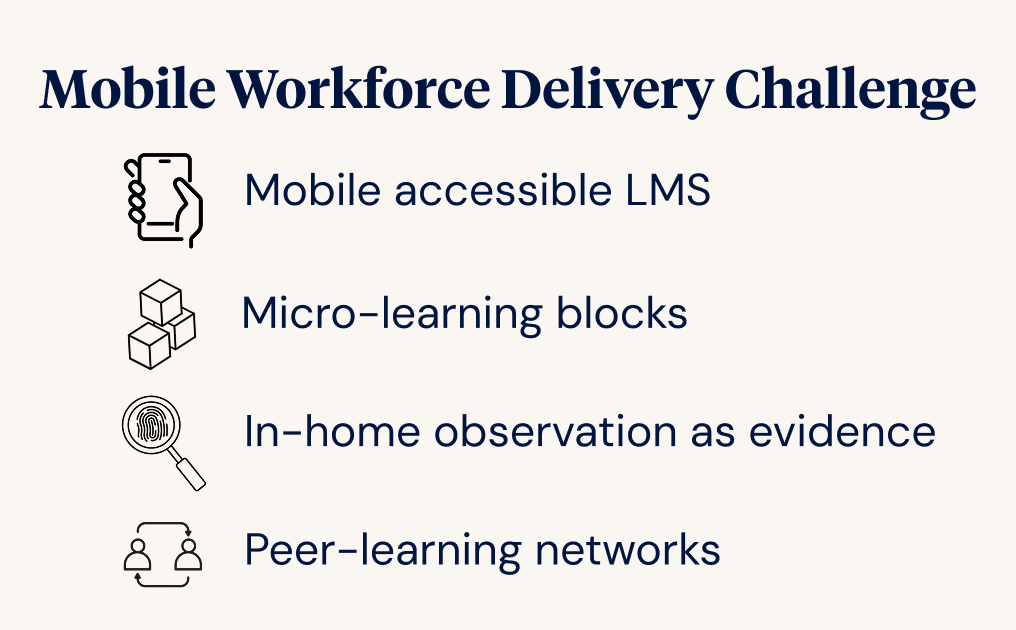
Four delivery patterns that work for mobile workforces:
1. Mobile accessible LMS. Workers can access their training via mobile app, allowing them to learn anywhere, anytime.
2. Micro-learning blocks. Under 10 minute training segments designed to fit between client visits. Distinct from full modules; designed to reinforce specific competencies on demand.
3. In-home observation as evidence. Supervisor visits to client homes for periodic observation. Tools like Ausmed Competency let supervisors complete the assessment on their mobile during the visit itself, recording the outcome instantly, no paper trail to carry back to the office.
4. Peer-learning networks. Structured peer-learning sessions (in person or virtual) where workers share what they have encountered in client homes. Both training and de-isolation.
End-of-life care delivered in the home is one of the aged care sector's most persistent workforce capability gaps. Most of the published evidence on this gap comes from residential aged care rather than home care specifically, but the pattern is consistent enough to be a reasonable warning sign for SAH providers. A scoping review of care-worker palliative education found that a large share of the unregulated care workforce has no formal palliative-care preparation and reports low confidence delivering end-of-life care (Norling and Donovan, 2022). Government market research involving hundreds of aged and primary care professionals similarly found clear gaps in palliative-care training and education pathways across the sector (Department of Health, Disability and Ageing, 2022). More recent qualitative work looking specifically at aged care reform has flagged the allied health workforce's capacity to deliver palliative and end-of-life care as an area providers need to actively build, including through structured, scenario-based training (Aged Care Reform and Allied Health Workforce study, 2025).
The traditional model assumed end-of-life would happen in a residential or hospital setting. SAH explicitly funds end-of-life delivery in the home, so this capability gap becomes directly relevant to home care providers in a way it wasn't previously.
The training implications:
- PCAs and DCWs need foundational palliative-care training, not just awareness
- RNs and ENs need expanded end-of-life clinical competencies
- Workers need bereavement-support training, both for themselves and for client families
- Advance care planning documentation needs to flow between client, family, GP, palliative-care specialist, and home-care worker
Providers who can demonstrate end-of-life care competence will increasingly be preferred by clients and by hospital discharge coordinators.
An SAH-aligned training matrix snippet
The table below shows a small extract of an SAH-aligned training matrix for two roles.
| Outcome / Topic | Personal Care Worker (Home) | Registered Nurse (Home) |
|---|---|---|
| 1.1 Person-centred care in home setting | Induction + annual Knowledge Verification | Induction + annual Knowledge Verification |
| 2.5 Incident management in home setting | Annual + scenario | Annual + scenario + clinical incident review |
| 3.3 Multi-provider communication and handover | Annual | Annual + interdisciplinary handover scenario |
| 5.7 Palliative care in home setting | Foundational + annual Knowledge Verification | Annual + competency observation |
| 5.5 Recognising deterioration in unsupervised settings | Annual + escalation drill | Annual + scenario + competency observation |
| Restorative-care principles | Foundational + annual | Annual |
The matrix structure mirrors a residential training matrix, but the topics and the evidence types reflect the home-care delivery reality.
Where to start
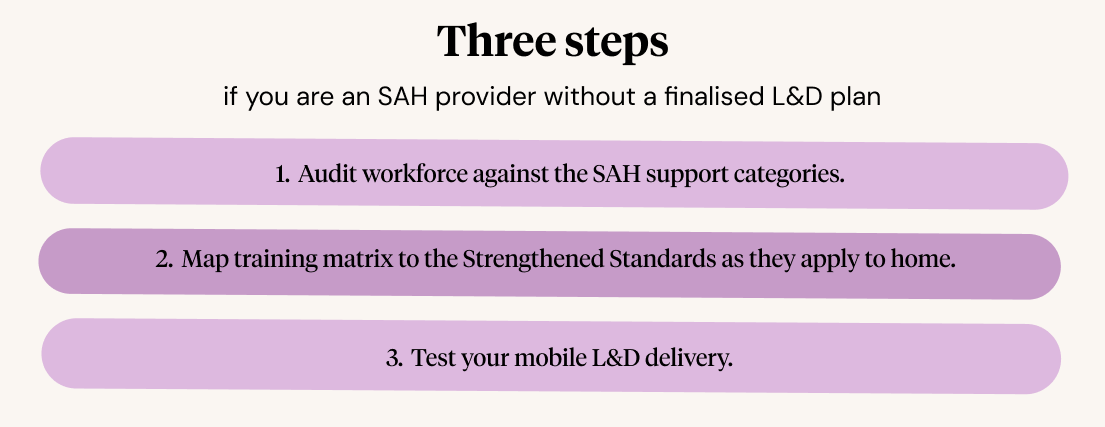
If you are an SAH provider entering the second half of 2026 without a finalised L&D plan, three steps are worth taking immediately.
1. Audit your current workforce against the SAH support categories. Identify gaps in clinical, allied health, restorative, end-of-life, and personal care capability. Determine which gaps you will close through training and which through workforce composition.
2. Map your existing training matrix to the Strengthened Standards as they apply to home delivery. Many providers have residential matrices that do not adapt cleanly to in-home delivery. Identify the Outcomes that need additional or contextualised training for home settings.
3. Test your mobile L&D delivery. If your current LMS is desktop-first and does not work well in a mobile environment, that is the operational blocker for the next two years. Your workforce needs to be issued mobile-first training.
References
Aged Care Quality and Safety Commission (2025) Strengthened Aged Care Quality Standards. Australian Government. Available at: https://www.agedcarequality.gov.au/providers/quality-standards/strengthened-aged-care-quality-standards (Accessed: 16 July 2026).
Aged Care Reform and Allied Health Workforce study (2025) 'Exploring the Implications of Aged Care Reform on Allied Health Workforce and Capacity to Deliver Palliative and End-of-Life Care', Healthcare. Available at: https://doi.org/10.3390/healthcare13243207 (Accessed: 16 July 2026).
Department of Health, Disability and Ageing (2022) What we're doing about palliative care. Australian Government. Available at: https://www.health.gov.au/topics/palliative-care/about-palliative-care/what-were-doing-about-palliative-care (Accessed: 16 July 2026).
Department of Health, Disability and Ageing (2025) Strengthened Aged Care Quality Standards – August 2025. Australian Government. Available at: https://www.health.gov.au/sites/default/files/2025-08/strengthened-aged-care-quality-standards-august-2025.pdf (Accessed: 16 July 2026).
Department of Health, Disability and Ageing (2026a) Support at Home program. Australian Government. Available at: https://www.health.gov.au/our-work/support-at-home (Accessed: 16 July 2026).
Department of Health, Disability and Ageing (2026b) About the Support at Home program. Australian Government. Available at: https://www.health.gov.au/our-work/support-at-home/about (Accessed: 16 July 2026).
Norling, T. and Donovan, H. (2022) 'Palliative care education for care workers in aged care: A scoping review', Collegian, 29(6), pp. 904-910. Available at: https://doi.org/10.1016/j.colegn.2022.04.009 (Accessed: 16 July 2026).