"If I tell you that every shift for tomorrow is filled, is that enough for you to feel confident about the quality and safety of tomorrow's supports?"
Ausmed's Elizabeth Sakal opened with that question at Skill-Based Rostering at Scale: What does good look like?, a sector conversation we hosted at our new Melbourne office on 16 September 2026. The answer from the room was "probably not". A filled roster tells you someone is turning up. It doesn't tell you whether the right person is turning up.
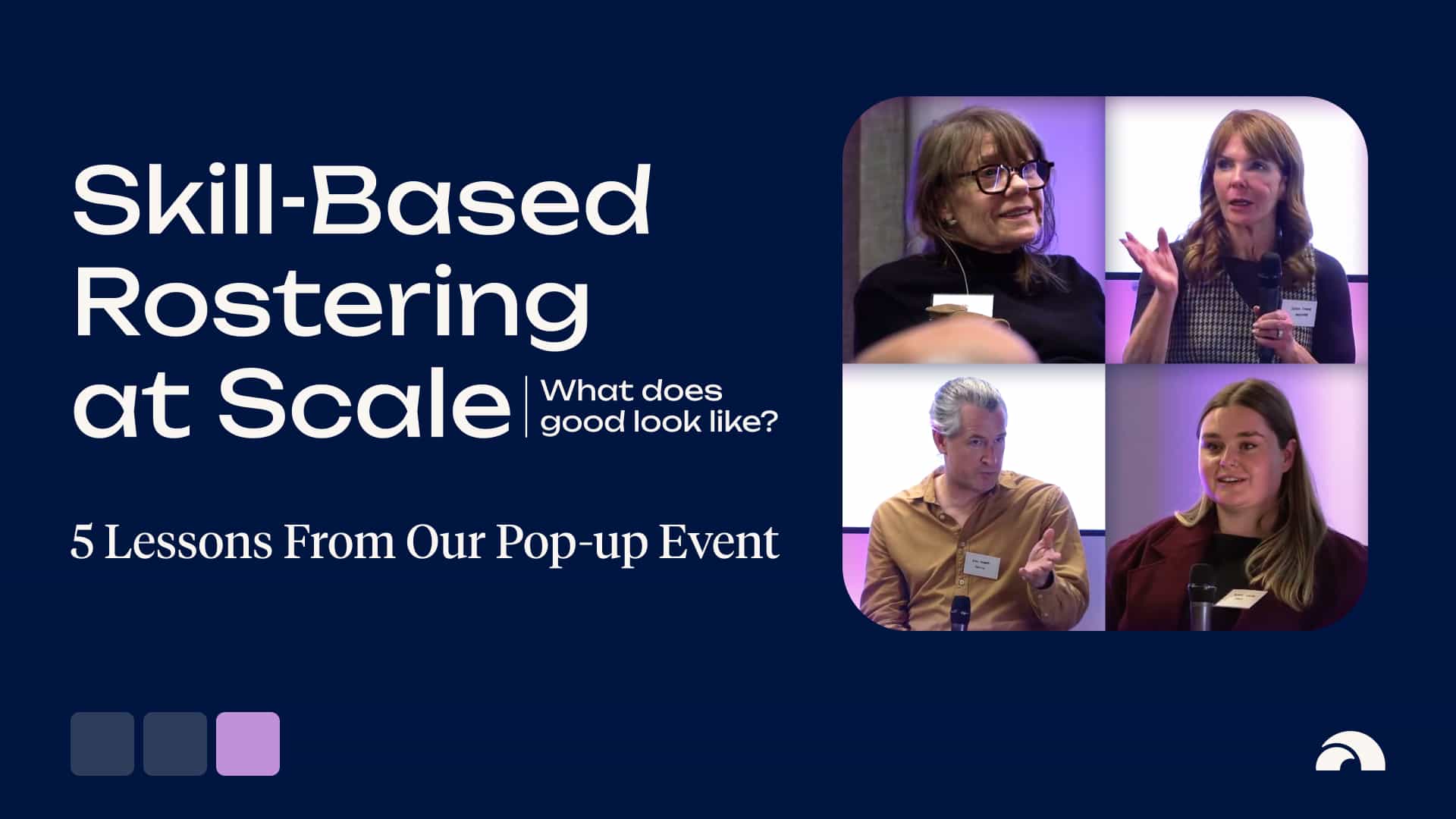
The panel brought four very different views to that problem. Hannah Cameron has lived with MS for 11 years and has been an NDIS participant for around seven. Sarah Creane, Chief Executive Officer / Co-Founder, MASCOTTE, has been Hannah's support worker for just over five years. Alex Hughes, Partner, Head Architect at Maica, builds rostering and scheduling software for providers. Taieri Walsh, founder of CORA Workforce, has worked as a support worker, support coordinator and workforce capability lead. Zoe Youl, Head of Clinical Governance at Ausmed, hosted, and a room full of providers, nurses, advocates, lawyers and technologists joined in.
With NDIS reform asking providers to show that worker matches are deliberate rather than random, here are five things we took away.
1. Rostering asks "is someone there?" Assurance asks "is it the right person?"
Elizabeth drew a clear line between rostering and workforce assurance. Rostering checks that a shift has a name against it. Assurance checks that the name belongs to someone with the skills, confidence and fit for that participant on that day.
She gave an example from the monthly disability group she runs. One participant is shy and needs their support worker close by to join the conversation over dinner. Their worker sits at the other end of the table, enjoying the discussion. Another participant wants to do as much as they can themselves and only needs help cutting their steak. Their worker takes over. Both workers might be good at the job. Neither was the right match.
"A person can be a great support worker, but just maybe not be the right support person for that participant."
Elizabeth Sakal, Ausmed
David, a registered nurse and clinical educator in the audience, used an example of a 6am sick call. You may have someone free to cover, but can they manage a PEG? Will they notice a resident developing a temperature or getting dehydrated? "They might have ticked off a competency somewhere, but how long has it been since that's been actually assessed?" He suggested providers separate hard constraints (current competencies, participant-specific sign-offs, screening, supervision) from softer ones (continuity, preferences, familiarity, language and cultural fit, travel and fair workload). Any override should come with a documented reason and a review, not an invisible workaround.
2. Compliance is the floor. Capability is built on top of it
A nurse from a boutique agency that places nurses in rural and remote areas described a firm rule: nobody goes out unless they're fully compliant with the agency's standards and the client's. "As much as you want to fill the position... we just won't place them." Holding that line, she said, usually means the right nurse turns up, and clients ask for them to stay.
Zoe agreed that up-to-date credentials, mandatory training and screening checks are the right place to start. But that's just foundational. Capability is what sits above it: the knowledge, skills and attitudes a worker brings to a specific person.
Taieri broke training into three layers:
- Compliance and core competency training. What a registered provider needs to pass audit.
- General specific training. Broader disability or support-type skills, such as a course on autism or high intensity supports.
- Support-needs-specific training. The specialised skills for one participant: someone with a history of support breakdowns, someone who distrusts workers, someone new to the NDIS, someone with an acquired rather than lifelong condition.
That third layer is usually left to be "learned on the job". Taieri argued it can be taught before the first shift, built from OT reports, behaviour support plans and everything else a provider knows about the participant, then adjusted as feedback comes in from workers.
"You're not always going to hire the best person straight off the bat, but you can develop them."
Taieri Walsh, CORA Workforce
Taieri made the same point later about advocacy, the skill Hannah and Sarah both named as most valuable in their relationship. It can be developed. "It's not efficient to leave it to luck."
3. Match on what matters most to the participant, and keep asking
Hannah described one support worker as "totally not matched" to her. It left her anxious. Then Sarah walked in. "From the very start, it was just right." Five years on, Sarah comes to Hannah's medical appointments, takes notes and explains things afterwards. They also share a love of fashion and shopping.
When asked what she would most want a provider to know, Hannah said: "Someone that's kind... you can cope with anyone in your space if they're a good person." She also warned that "you can be perfectly matched on paper" and still find the person isn't right.
Sarah offered a practical way to make that less of a lottery. Don't just ask a participant what they like. Ask how important each thing is to them. If Hannah has 100 things on her list, a provider may only be able to meet 50 or 60.
"Are we meeting the ones that are most important to her? If we're going to drop anywhere, we need to drop the ones she doesn't place the greatest value on."
Sarah Creane, support worker, CEO and Co-Founder of MASCOTTE
Alex Hughes from Maica wanted the same signal flowing back into rostering systems. Preferences like gender or language are captured today, but feedback from actual shifts rarely is. If a coordinator filling a sick call could see that a worker has met the participant before and the visit went well, they'd make a better call.
The room added a caution. One attendee from a dementia service said scores shift with how a person feels on the day, and some participants rate every worker 10 out of 10 because "it's better the devil I know". Feedback helps, but it needs a person reading it with context.
4. Map your skills now, before the SCHADS Award changes
Tamsin Lawrence, Director at Australian Business Lawyers & Advisors (Abla) reminded us of key award and pay condition requirements. Skill-based rostering already has to work inside the SCHADS Award: classifications, break rules, and the extra cost of cancelling or swapping shifts.
She flagged a bigger shift ahead. As a result of a gender undervaluation case, Tamsin expects the award's disability and home care classifications to be replaced next year by a broader structure of around 10 levels. Those levels will be based largely on qualifications plus "equivalency", but the award is unlikely to spell out how equivalency should be judged.
That leaves providers exposed. A worker with a Certificate III and 10 years of experience could argue they should be paid at diploma level. Covering a shift in another home could raise the question of higher duties.
"If you haven't done that work, it's going to be very difficult, frankly, to pay your people correctly."
Tamsin Lawrence, Australian Business Lawyers & Advisors
Her advice:
- Define the skills each role actually needs, separate from the qualification title.
- Map general and specific skills against each classification level, so you can show what a worker has and what they're missing.
- Do the assessment at the point of hire, so people start at the right level.
- If you're a larger provider, start now rather than waiting for the detail.
A skills matrix built for rostering and one built for pay classification are close to the same piece of work. Doing it once serves both.
5. Use systems to give people time to make the match
Near the close, Jan Tenenberg, CEO of rostering software company Maica, reflected on Hannah and Sarah's story and concluded that no amount of computing power will produce that relationship at scale. "Maybe we're asking these systems to do the wrong things." Jan suggested flipping the question.
"What administration can we take away to give the human beings the space and time to build these relationships? If we can achieve that, rostering could take care of itself."
Jan Tenenberg, CEO, Maica
Taieri agreed. Let systems handle data entry and admin, and leave the matching to people who have met the participant and know the workers.
The data problem is still real. Austin Chia, Deputy Chief Operating Officer, Scope, said providers are expected to know each participant's support needs, yet OT reports, health assessments and behaviour support plans sit in different places.
Alex pointed out that in larger organisations, recruitment, HR and intake teams each hold half the picture and rarely connect. Kate Renzenbrink, Chief Clinical Informatics Officer at the Royal Victorian Eye and Ear Hospital, said healthcare has too much information rather than too little. The work is getting the right information to the right person at the right time. She prefers "data navigated" to "data driven", because it keeps people at the centre.
By the end of the night, the room had sketched four groups of information a skill-based roster needs to connect:
| Bucket | What sits in it |
|---|---|
| Workforce basics | Role, credentials, availability, experience |
| Verified capability | Mandatory training, competency assessments, participant-specific and support-needs training |
| Participant requirements | Support and communication needs, risks, preferences, and how much each one matters |
| Support worker perspective | How workers experience their shifts and matches over time, not just in a yearly engagement survey |
Will Egan, CEO from Ausmed added that fourth bucket, and it ties back to retention. Sarah described a period when another professional in Hannah's care team was less than kind, and how isolating that was. Taieri said that when supports break down, the reason workers give most often is "I didn't feel supported". How you treat workers when you roster them, and when they call in sick, shapes whether they stay.
Where to start
Nobody on the night claimed to have solved skill-based rostering. But the conversation pointed to a few first moves for providers:
- Treat compliance as the minimum and track capability separately, including when each competency was last assessed.
- Ask participants how much each preference matters, not just what their preferences are.
- Build participant-specific training from the reports and plans you already hold.
- Map role skills to award levels before the SCHADS changes land.
- Give coordinators the time and information to make the match, and listen to workers about how it's going and an opportunity to help communication between roles so that the "full picture" is built.
As Zoe put it at the start, the stories of great matches are out there. The work is making them 90 or 95% of the stories rather than the exception.
Watch the full event
Hear Hannah, Sarah, Taieri and Alex in their own words, plus the questions from the room, and an address from both Ausmed's Elizabeth Sakal and Will Egan.
Panellists

Sarah Creane, CEO and Co-Founder of MASCOTTE Aged Care Solutions. Mascotte offers tailored solutions to aged care needs, including clear guidance, practical support, coordination and advocacy. Sarah brought a clinical, governance, executive workforce and lived-experience perspective to our evening.

Taieri Walsh is Founder of CORA Workforce, an NDIS compliance training, credential tracking and workforce capability software for Australian disability providers. Taieri's experience spanning frontline support, coordination, team leadership and workforce capability was a valuable contribution.

Alex Hughes is Partner and Head Architect at Maica, an innovative NDIS and Aged Care software designed for providers to streamline operations, enhance care delivery, and boost efficiency. He brought a provider systems, rostering, scheduling and integrations perspective to the panel.
Hannah Cameron has lived with MS for 11 years and has been an NDIS participant for around seven years. Hannah shared what matching means in practice: not only formal skills and capability, but whether the worker is the right fit for the person, their needs and their support team.